How Long Should a Resume Be for 15 Years Experience?
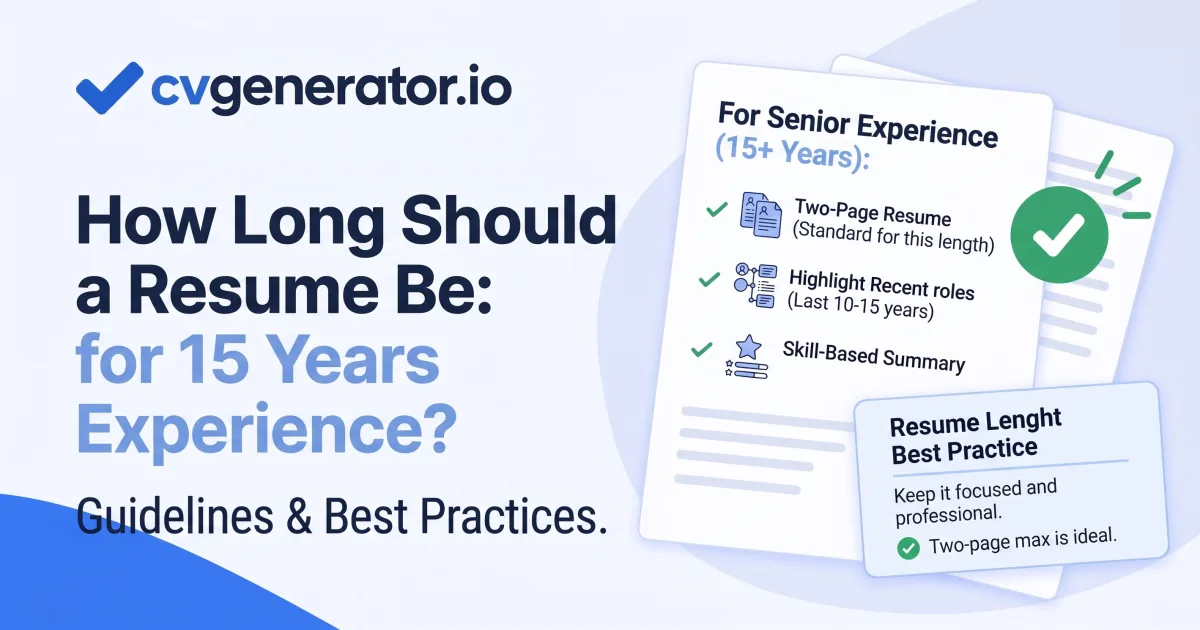
How long should a resume be for 15 years experience? The short answer is one to two pages, with two pages being the standard for most professionals at this stage. The reasoning matters more than the number: recruiters scan quickly on a first pass, so your resume needs enough room to show progression and results without burying them in a career autobiography. This guide covers what to keep, what to cut, and how to format two pages cleanly. If your document is already written, an ATS checker can confirm nothing is being lost before it reaches a human reader.
In this article
Two Pages Is the Norm at This Level
For a professional with 15 years of experience, a two-page resume is the accepted norm across most industries. Recruiters and hiring managers are trained to scan resumes quickly, often spending under a minute on a first pass. A two-page document gives you enough room to show career progression, key achievements, and relevant skills without forcing you to cram everything onto a single page.
A single-page resume at your level can read as a red flag. It may suggest either that you have not done anything noteworthy in 15 years or that you struggle to prioritize information. Conversely, a three-page resume for a standard mid-senior role reads as self-indulgent. Two pages is the middle ground where you demonstrate depth while respecting the reader's time.
The exception is if your 15 years include early-career jobs that are now irrelevant to your current direction. In that case, a one-page format with a strong summary and a focused list of recent achievements can work. But for most professionals, two pages strikes the right balance of detail and brevity.
What to Cut and What to Keep
The biggest challenge at 15 years is not writing the resume, it is deciding what to leave out. You cannot list every responsibility you have ever held, and you should not try. The goal is to tell a focused story about the value you bring to the next employer.
Focus on your most recent 10 to 12 years. That period is the most relevant to your current search and what a recruiter examines first. For each role, emphasize accomplishments over responsibilities and use numbers wherever possible. Instead of "responsible for managing a sales team," write "grew regional sales by 23% within two years while leading a team of eight." Show impact, not activity.
For older roles, list them without bullet points, giving just the job title, company, and dates, or group them under a heading like "Earlier Career Experience." For example: "Senior Analyst, ABC Corporation (2010-2014); Junior Analyst, XYZ Ltd (2008-2010)." This preserves the timeline without a page of outdated detail.
- Cut technical work from your first five years if you have since moved into management
- Remove jobs you held for under a year unless they led directly to a promotion
- Delete bullets describing duties rather than outcomes, such as "participated in weekly status meetings"
Ready to put this into practice?
Check your resume for freeFormatting Two Pages Without Bloating It
Length is only half the challenge. A two-page resume with large gaps, inconsistent margins, or poorly placed headings hurts your chances as much as one that is too long. Use standard margins of roughly half an inch to one inch, keep body text between 10 and 12 points, and use a consistent bullet style throughout. These details signal organization and attention to detail.
Manage white space carefully. Never leave the second page holding a single line or bullet; adjust spacing so content fills both pages evenly. If you are slightly over the page break, tighten your language before you shrink margins, and cut a weak bullet before cutting content you actually need.
Put your strongest information on the first page. Recruiters often remember mainly what they saw there, so the top half should carry your professional summary, key skills, and most recent job. The second page holds supporting details like earlier roles, education, and certifications. A two to three sentence summary at the top sets the tone: "Operations leader with 15 years of experience in supply chain and logistics, focused on reducing costs and improving delivery times across national and international networks." A resume builder with prestructured layouts can help keep spacing consistent.
Ready to put this into practice?
Build your resume for freeWhen More Than Two Pages Is Acceptable
Some situations make a three-page or longer resume acceptable, even expected. The most common is executive work. If you are targeting C-suite, board, or senior director roles, recruiters often expect a detailed history, because the stakes are higher: a company hiring a CFO wants to see the full arc of financial leadership, including strategic initiatives and large-scale transformations.
Certain industries have their own conventions. Academic roles usually require a curriculum vitae, which is a different document and can run many pages. Government positions, particularly in the federal sector, may require a detailed account of your experience. Technical fields where patents, publications, or large project portfolios are central to credibility also justify a longer document.
Even then, treat extra length as the exception. Before writing a third page, ask whether every item on it directly serves the job you are applying for. If not, cut it. Fifteen years of experience does not mean showing all 15 in equal detail; it means showing the right 15. For most professionals, two well-formatted pages will outperform any other option. When you are ready to send applications, a job tracker helps you tailor and monitor each version.